
AI SEO vs. Google SEO: How to Structure Your Website So Both Recommend You
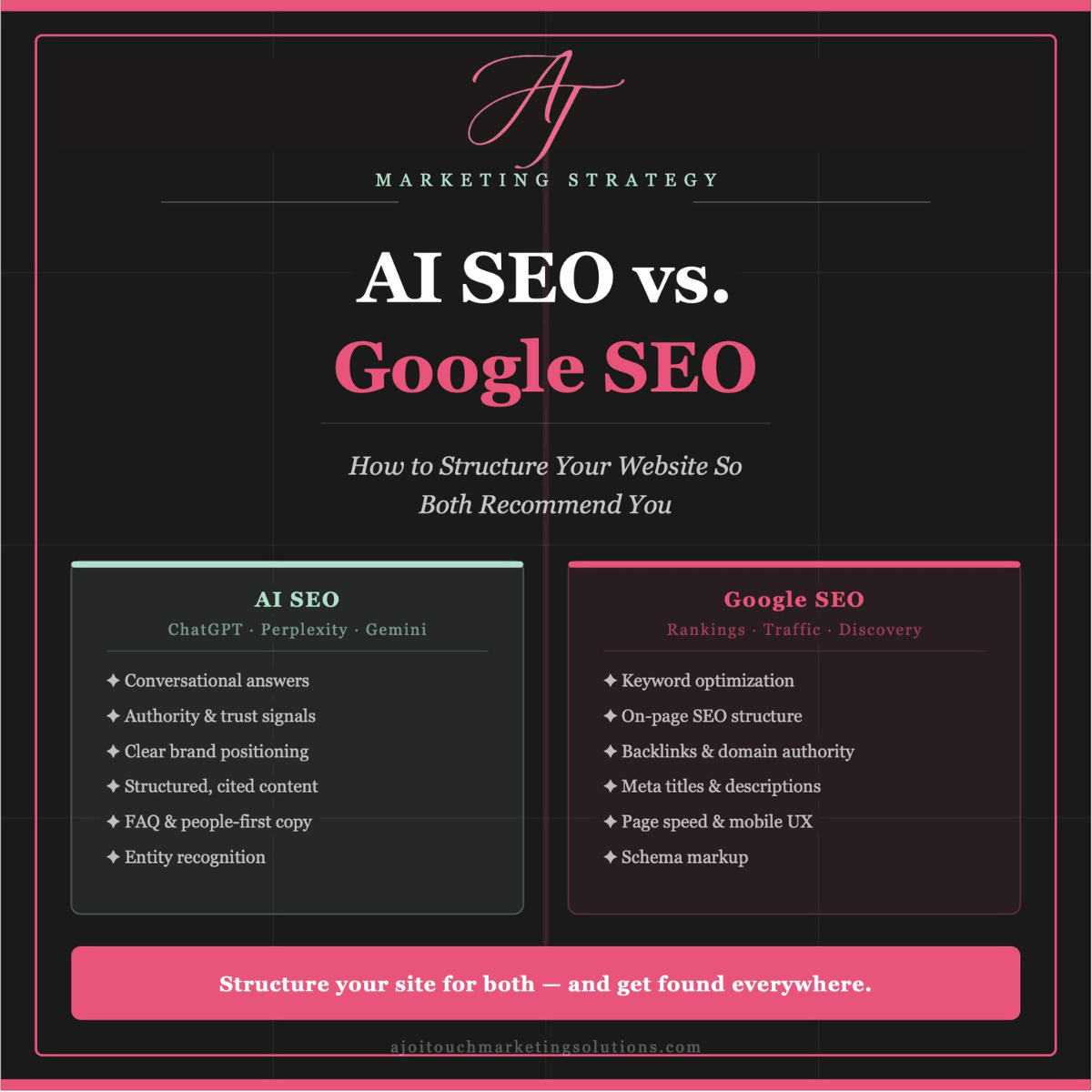
Gone are the days when all you had to do was consistently publish quality targeted content and strategically plug in relevant keywords throughout your website headers, tags, and text to rank higher for Google search. While that is still great to do, there is more you have to do to be visible in this current competitive landscape that is vying for your audience’s attention. This commands a more multi-faceted approach. It is becoming more important than ever to prime your site for both Google and AI search.
So, what’s the distinction between Google SEO and AI SEO and what does each search tool deem valuable?
By 2026, the line between Google SEO and AI SEO has almost vanished, leading to a combined strategy. Traditional SEO still focuses on ranking blue links with keywords and backlinks. In contrast, AI SEO, such as Google AI Overviews, aims to provide clear, reliable, and well-structured answers that can be easily cited.
Google Maps doesn’t just supply a list of top-ranked businesses. With it’s new “Ask Maps” feature, it searches posted business recommendations and website content to provide the most accurate recommendations based on your search question asked and the detailed criteria specified.
Here is a short list of methods you can start practicing now that will make a huge impact.
Don’t Just Optimize with Relevant Keywords, Hone In on Topics
Headings and titles play a key role in your content. Make them as descriptive, clear, and concise as possible to help both AI and Google understand your page. Try using a question and answer format, where you ask questions your audience cares about and then provide clear answers with supporting details. For formatting, use H2 and H3 for your headers.
Optimize for Search Intent & Google’s AI Overviews (AIO)
Building your website is just the first step. To keep it effective, you need to check in on it regularly and update it often. Add new content that speaks to the problems you solve for your clients and addresses their most important needs.
The goal is to shift your focus from keyword stuffing to provide user-first content that gives detailed answers to their questions (Answer Engine Optimization) with multiple perspectives, is clear, and shows your expertise.
Fundamental SEO Best Practices are Still Important
When it comes to optimizing your website for search, the tried and true methods of providing high-quality, user-focused content, conducting keyword research to plug in relevant ones throughout your headings, copy, meta descriptions and tags, as well as making sure your site is high-speed and mobile-friendly, is still very important.
Maintain this and also practice these 5 important concepts of SEO:
Identify popular searches of your target audience and the “why” behind their search
Optimize your website headings and text, as well as your blog content and image descriptors for search
Conduct routine site audits to make sure pages are still loading properly, links are still working, and determine whether or not keywords need to be updated
Establish credibility and authority with citations from reputable sources
Create a user-friendly site that highlights relevant experience, expertise, authority, and trustworthiness (EEAT)
Clarity Optimization, Be an Answer Engine
Begin your text by giving a clear answer to your main question, so readers instantly know what to expect. From there, make your content even more helpful by adding supporting paragraphs, easy-to-scan bullet points, real-world examples, or quick stats. Make your advice practical and relatable. Including an FAQ section at the end not only answers common follow-up questions but also makes your content friendlier for both readers and AI tools.
I would love to help you kickstart your content plan to improve your visibility and help connect you with those who need your services most.
